
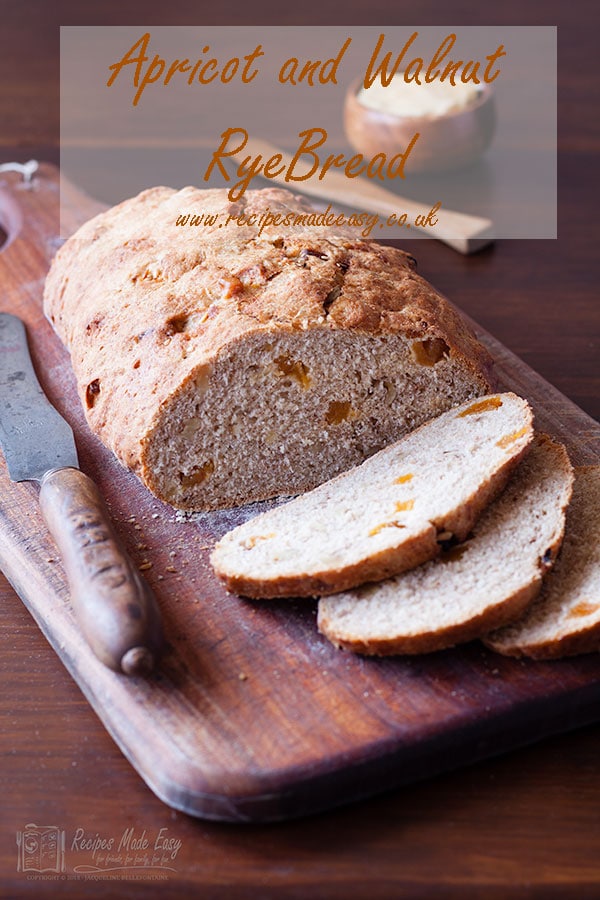
This semi-sweet Apricot and Walnut Rye Bread is delicious eaten on its own, spread with butter or lightly toasted. It also goes well with cheese and cold meats.
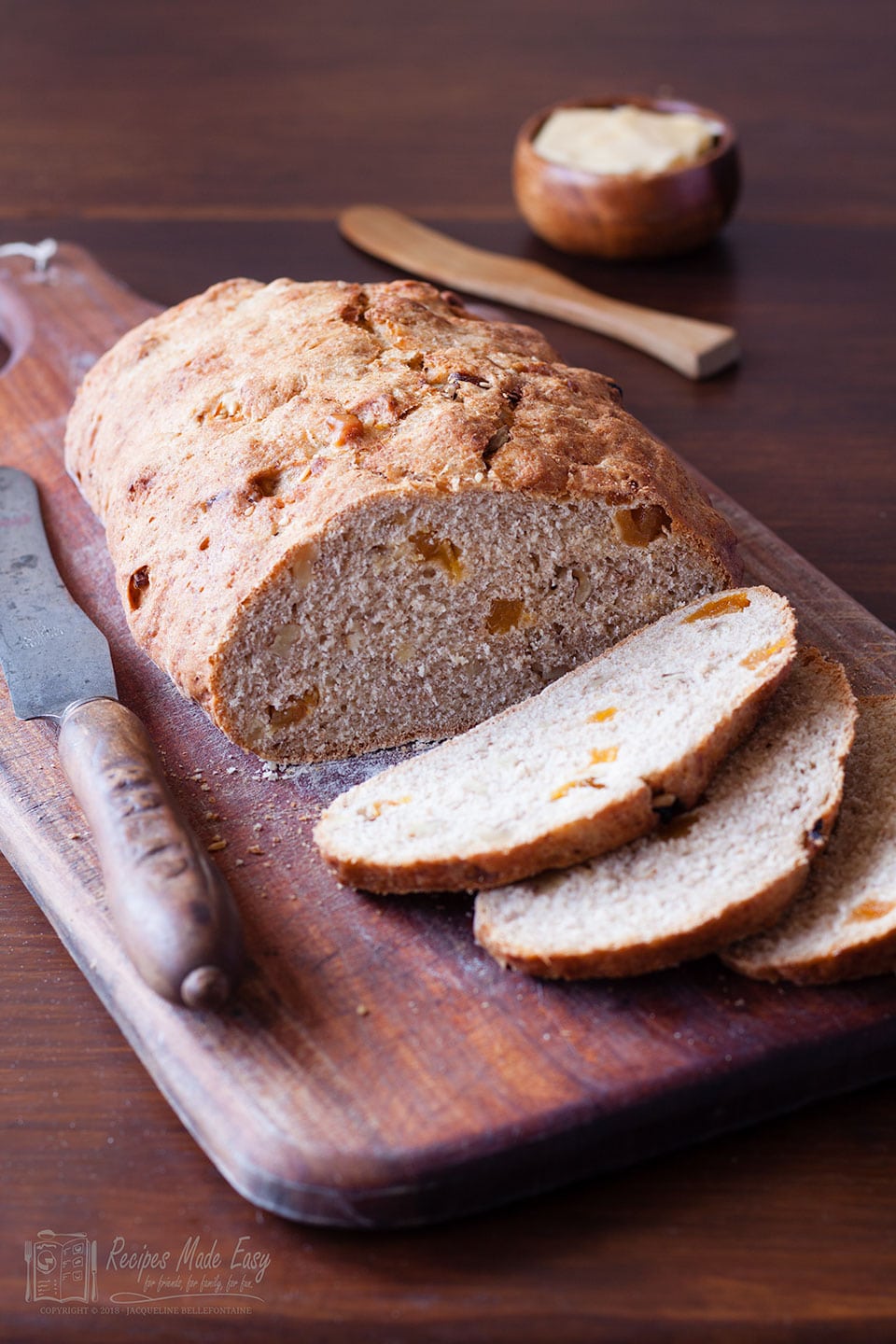
A light Rye Bread
Now I'm not a huge fan of the very dark dense rye breads, so I have opted instead for a light rye flavoured with chopped apricots and walnuts. It is loosely based on a recipe by a friend of mine Carol Tennant from her book Knead (MQ Publications Ltd).
It uses a method in which you first make a 'sponge' which is a wet yeasted dough. Once this dough is really active then you mix in the rest of the flour and other ingredients to make the loaf. It as extra step to the standard way of making bread but it does extra flavour to the end loaf.
NO Knead
Time is your friend here. This loaf does need a little preplanning as it takes a while to produce but on the plus side not only will you be rewarded with a delicious tasting loaf but you will have avoided any strenuous mixing and kneading as the gluten is given to time to develop on it own.
How to Serve
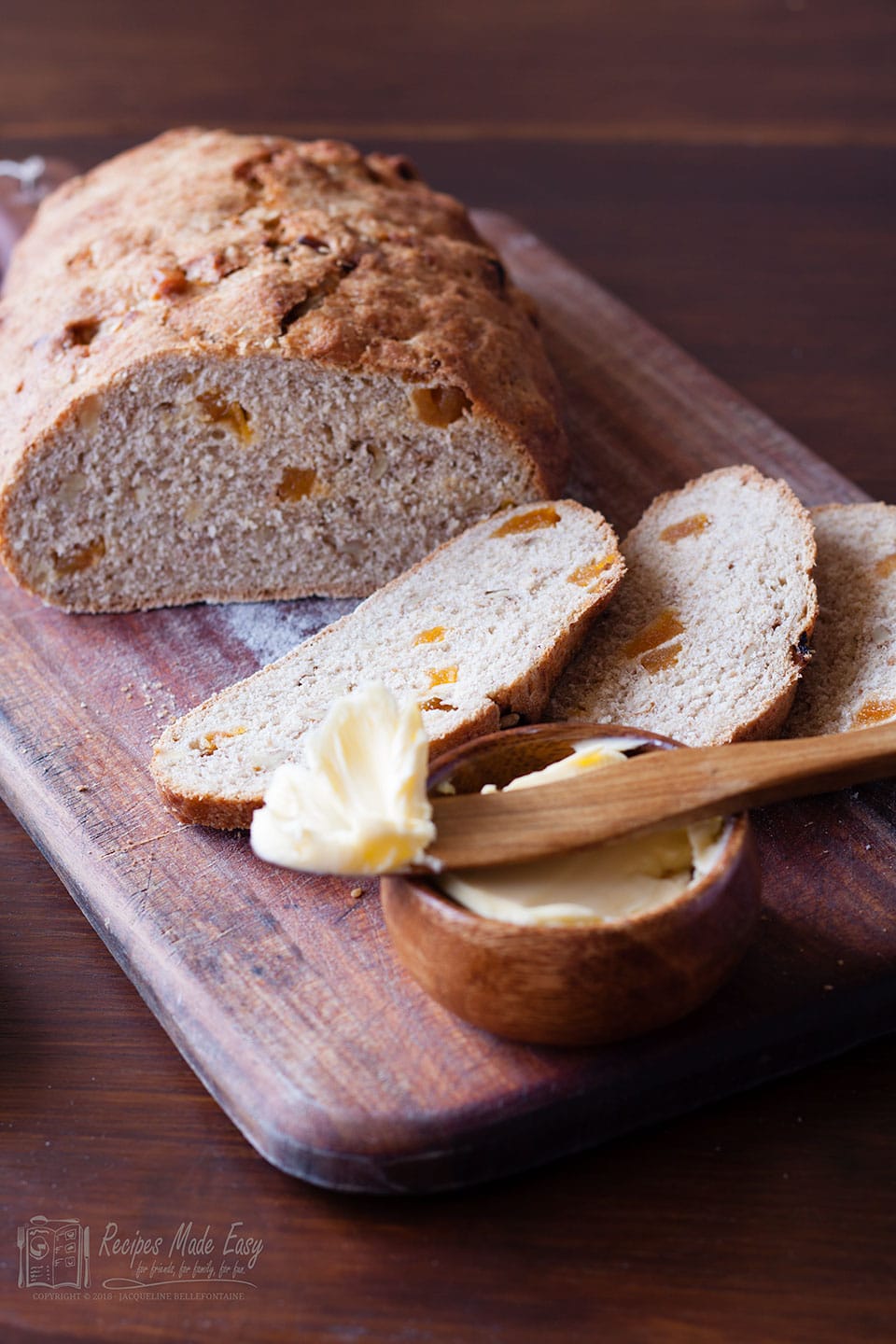
As I said it in my intro it is delicious on its own, fresh or lightly toasted but you could even use it to make an open sandwich. Try topping with some cream cheese or creamy goat's cheese, a sprinkling of nuts and a drizzle of maple syrup - we are talking seriously scrummy!
Apricot and Walnut Rye Bread Step by Step

Apricot and Walnut Rye Bread
Ingredients
for the 'sponge"
- 150 g wholemeal rye flour
- 100 g strong plain bread flour
- 1 teaspoon easy blend yeast
- 250 ml cold water
for the bread
- 250 g strong plain bread flour
- 1 tablespoon light muscovado sugar
- 1 teaspoon salt
- ½ teaspoon easy blend yeast
- 4 tbsp full fat milk
- 75 g dried apricots chopped
- 50 g walnuts chopped
Instructions
To make the 'Sponge'
- Combine the ingredients for the sponge together in a large mixing bowl. Cover and allow to rest at room temperature for about 4 hours.
To make the bread
- Once the mixture has doubled in bulk and is light and airy add the remaining ingredients for the bread and mix to form a soft sticky dough.
- Shape into a ball and leave in the bowl, covered at room temperature for 1 - 1½ hours or until doubled in size.
- Shape the dough into a neat oval and place on a well-floured baking sheet. Lightly brush with a little oil, cover loosely and leave until doubled in size (about 1 - 1½ hours).
- Preheat the oven to 220℃ (200℃ fan)/425°F/gas mark 7. Place a heavy baking sheet in the centre of the oven to heat up and an empty shallow roasting pan in the bottom of the oven. Get a jug of about 300ml (½ pt cold water ready
- When the loaf is ready to bake quickly slide off the floured baking sheet onto the hot oven sheet. Then quickly pour the jug of water into the roasting tin in the bottom of the oven shutting the oven door quickly to entrap as much steam as possible.
- Reduce the oven temperature to 200℃ (180℃ fan)/400°F/gas mark 6 and bake for 35 -40 minutes or until the loaf has a golden and sounds hollow when tapped on the bottom. Transfer to a wire rack to cool.
Notes
Pin for Later
Agustina says
Are you sure the quantities are right? It was so liquid, I had to add an extra cup of flour.
Jacqueline Bellefontaine says
Yes the quantities are correct Im not sure where you went wrong. when did you add the extra flour? For the first stage of the recipe (step 1) the dough will be every liquid. During this time the wholemeal and flour will absorb some of the moisture so that when you add the remaining flour in step 2 you should end i up with a soft dough with good hydration resulting in a lovely soft crumb. Did you leave it for the full 4 hours before adding the remaining flour.
Mike O. says
Hello, would a covered dutch oven instead of the baking sheet/water pan method work as well, worse, or better? Wondering if this would change anything for better or worse on this particular recipe.
Jacqueline Bellefontaine says
While I have not tried it for this particular recipe I'm sure you could use a covered dutch oven to bake this bread with great results. I sue an Eartherware Cloche to bake my sourdough bread in and I find it gives it a great crust and I have also cooked it in a cast iron dutch oven with a similar good crust.
Kat (The Baking Explorer) says
What a stunning looking bread - perfectly baked!
Jacqui Bellefontaine says
Thank you. Glad you like it.
Dee says
Can you do the initial sponge and maybe leave in a fridge overnight to double in size rather than at room temperature for 4 hours ?
Jacqui Bellefontaine says
I have not tried it for this specific recipe but I can see no reason why it would not work. I certainly know of recipes that use that technique. If you do give it a go let me know what happens I would love to add it as a tip.
Anca says
The apricot is an unexpected addition. I'm not sure how sweet it makes the bread, but it does look amazing.
Jacqui Bellefontaine says
The apricot only gives it a hint of sweetness which is why the bread is also good with cheeses and meats.
jenny Paulin says
I love the bursts of orange dispersed inside your rye loaf Jacqueline. it looks very tempting and pretty. AND less calorific than buttery danish pastries lol like I made! Only 2 more bakes and then back to salad all the time then........ LOL! thank you for finding the time to bake along again xx
Jacqui Bellefontaine says
Much less calorific than Danish pastries (if you do not spread with too much butter) and i think as delicious.